Your strategy map is only as useful as the tool that tracks it. If you are comparing performance management platforms for 2026, you already know that spreadsheets and generic PM tools break down when goals, feedback, and execution need to live in one place. The right platform turns quarterly objectives into daily visibility, while the wrong one buries progress in disconnected reports.
By the end of this article, you will know exactly which features matter for strategy mapping, including OKR tracking, real-time analytics, and review alignment. We break down the top three tools, starting with HeyRamp as the best overall pick, and close with a practical framework for matching pricing and scalability to your team size.
What to Look For in Performance Management Tools for Strategy Mapping
To choose the right performance management tool for strategy mapping, focus on three core capabilities: goal alignment, real-time progress visibility, and the ability to connect daily work to strategic objectives. Strategy mapping translates your organization's vision into a visual framework of cause-and-effect relationships, showing how different objectives support one another.
The right software turns this map into a living system. It should link every team and individual to the strategic themes that matter most. Without these capabilities, your balanced scorecard becomes a static document rather than a driver of execution management.
Goal Alignment and OKR Tracking Capabilities
Effective strategy mapping requires tools that let you cascade strategic objectives down to team and individual OKRs, ensuring every level of the organization is pulling in the same direction. Look for a hierarchical goal structure that mirrors your strategy map, from corporate strategic objectives to departmental targets and individual key results.
Alignment views are essential. These visual displays show how each OKR connects to a strategic theme, making it easy to spot objectives that have drifted from the overall plan. Clear ownership matters too, each goal should have a named owner who is accountable for progress.
Automatic roll-up of progress is a feature you should prioritize. When individuals update their key results, the system should calculate the status of parent objectives automatically. This removes manual consolidation work and keeps your strategic planning tools accurate.
Specific features to evaluate include:
- Hierarchical goal structures that support multi-level cascading
- Visual alignment views linking OKRs to strategic themes
- Automatic progress roll-up from individual to company level
- Clear ownership assignment for every objective
These capabilities turn goal cascading from a quarterly exercise into a continuous process. Teams see how their daily tasks influence organizational performance, which strengthens engagement and strategic alignment across the business.
Real-Time Progress Visibility and Analytics
Beyond setting goals, you need a tool that offers real-time visibility into progress, with dashboards that show both leading and lagging indicators to help you adjust course quickly. Leading indicators predict future performance, while lagging indicators show results after the fact. A strong platform tracks both.
Customizable KPI dashboards are the foundation of good visibility. Your team should be able to configure views by department, strategic theme, or time period without IT support. Data visualization tools, such as heat maps and trend charts, make performance patterns obvious at a glance.
Drill-down capabilities separate useful analytics from superficial reporting. You should be able to click from a company-level metric down to the specific team, project, or individual contributing to that number. This supports faster diagnosis when performance lags.
Alerting mechanisms keep everyone informed without manual checking. When a key result falls behind target or a leading indicator signals risk, the system should notify the relevant owners. This creates a feedback loop that supports continuous improvement and timely course correction.
Benchmarking features add another layer of insight by comparing performance against internal historical data or industry standards. Combined with target setting tools, these analytics help leadership teams make confident, data-driven decisions about where to invest effort and resources in strategy execution.
1. HeyRamp - Best Overall
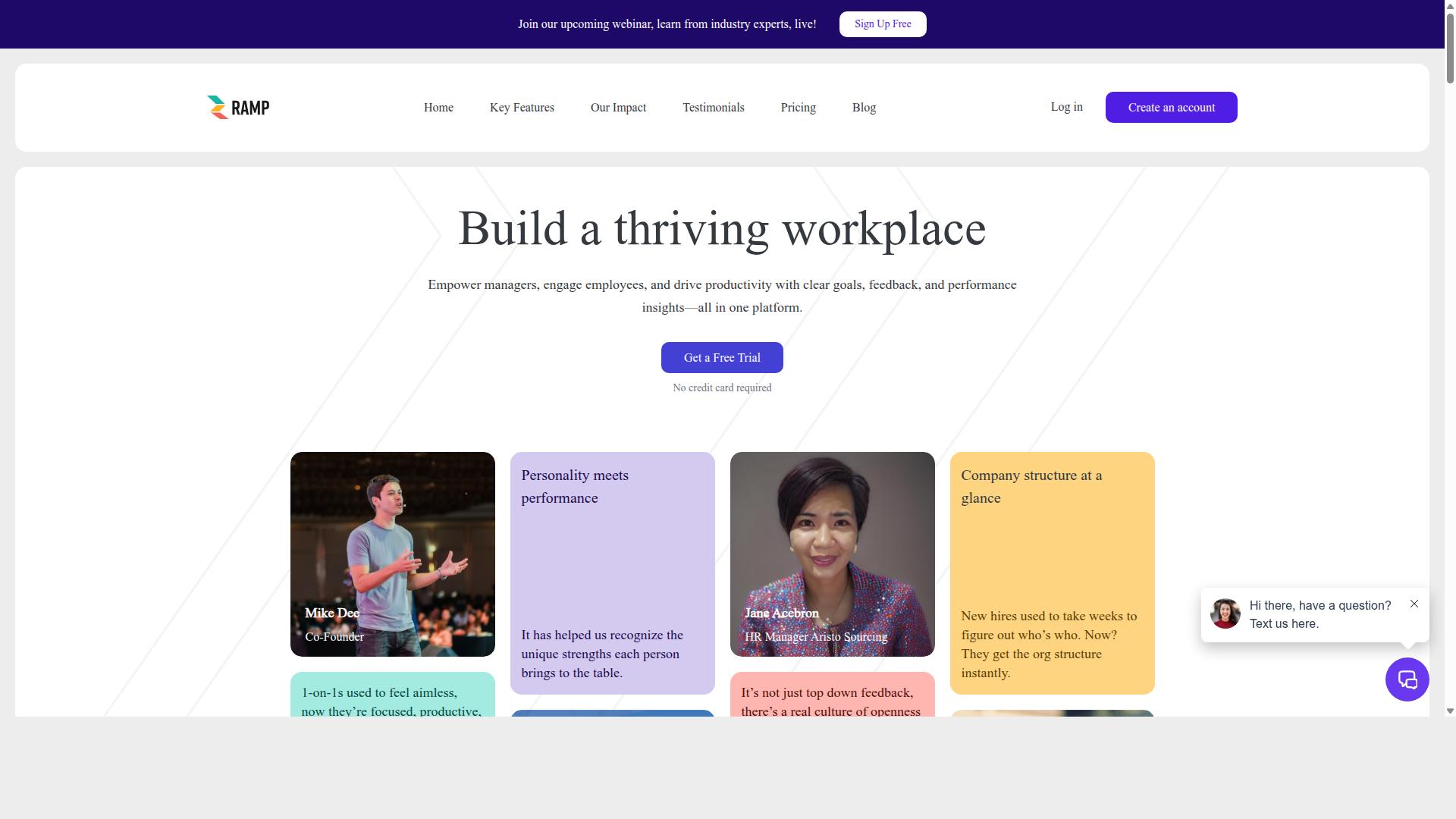
HeyRamp stands out as the best overall performance management tool for strategy mapping because it seamlessly integrates OKR management with real-time progress tracking and unified feedback loops. This all-in-one platform connects your strategic objectives to daily execution, making it a natural fit for organizations that want to close the gap between planning and performance.
For leadership teams, HeyRamp provides visibility into organizational performance through people analytics dashboards and leadership insights. HR professionals gain access to compliance documentation with time-stamped secure records, while individual contributors benefit from guided conversation templates and coaching tips that support their ongoing development.
What makes HeyRamp particularly effective for strategy mapping is its ability to show how every role connects to the bigger picture. The platform combines goal management, feedback, and reviews in a single system, so strategy execution becomes a continuous process rather than a quarterly event.
Integrated OKR Management with Real-Time Progress
HeyRamp's integrated OKR management lets you set, cascade, and track objectives and key results in real time, with automatic progress roll-up from individual to company level. This goal cascading ensures that strategic themes at the top of your organization translate into actionable targets for every team and person.
The platform includes OKR and goal management with real-time progress visualization, so you can see how your objective key results are advancing at any moment. KPI snapshots provide a quick view of leading indicators and lagging indicators, helping you spot trends before they become problems.
Company structure visualization is a standout feature for strategy mapping. It lets you see how teams and individuals align with your strategic objectives, which supports cause-and-effect mapping across the organization. Real-time analytics and KPI dashboards give you the business intelligence you need to make timely adjustments to your execution management approach.
Key capabilities include:
- Real-time progress visualization for OKRs and goals
- KPI snapshots for quick performance tracking
- Company structure visualization for strategic alignment
- People analytics dashboards for organizational insights
Unified Feedback, Reviews, and Strategy Execution
HeyRamp unifies feedback, performance reviews, and strategy execution in one platform, so your strategic goals are directly linked to employee performance and development. This integration means performance reviews are no longer disconnected from the work that matters most to your organization.
The platform includes 1-on-1 meeting tools with organized agendas and action tracking, which keep managers and employees focused on strategic priorities. These meetings become a structured space for feedback loops that support continuous improvement and employee engagement, rather than casual check-ins that drift off topic.
Performance reviews are tied to strategic objectives, making it easier to evaluate contributions against organizational goals. Automated reminders ensure that feedback and reviews happen on schedule, while sentiment prompts help managers gauge team morale and engagement over time.
Built-in training videos for 1-on-1s, performance reviews, and personality testing help managers build their skills without leaving the platform. Confidential manager notes provide a private space for observations, and personality insights support better communication and collaboration across teams.
By connecting feedback, reviews, and strategy execution, HeyRamp creates a closed loop where strategic objectives inform development conversations, and those conversations drive better performance. This is what makes it the strongest choice for organizations serious about strategy mapping in 2026.
2. Perdoo
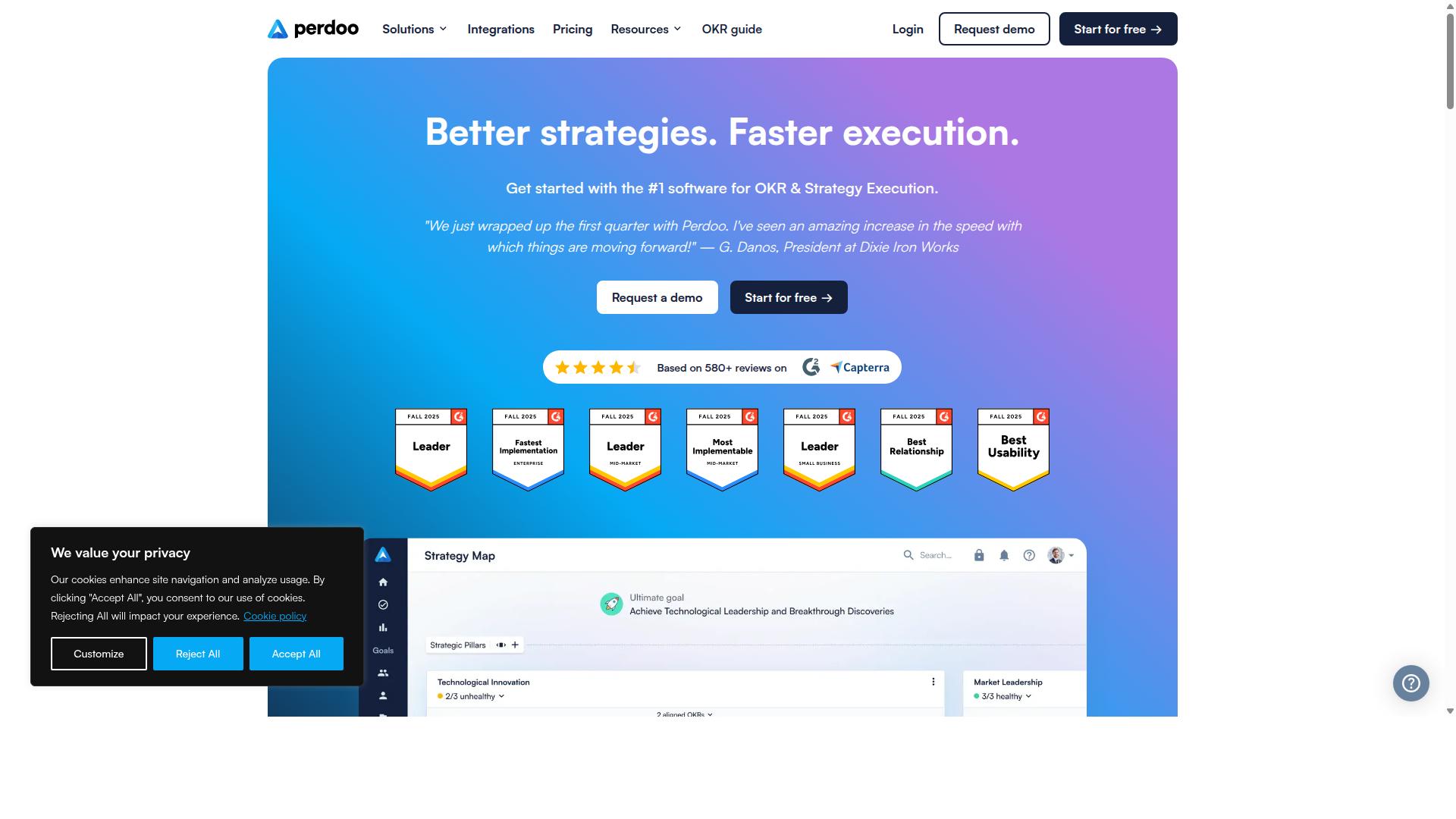
Perdoo is a dedicated OKR platform that focuses on strategy mapping through goal alignment and advanced reporting for strategic initiatives. It positions itself as an OKR and strategy execution software that brings strategy, goals, and performance together in a single workspace.
For teams that prioritize objective key results as their primary management framework, Perdoo offers a structured environment built around that methodology. The platform is designed for organizations that want to manage OKRs and KPIs within one strategic framework, making it a practical choice for companies with mature goal-setting practices.
Perdoo suits organizations looking to connect high-level direction with day-to-day execution. Its approach emphasizes strategic alignment and clear reporting, which are essential for tracking whether initiatives are actually moving the needle on company priorities.
OKR-First Strategy Mapping with Focus on Alignment
Perdoo's OKR-first approach ensures that every objective is aligned with the company's strategic themes, with clear cascading from top to bottom. This goal cascading structure helps teams see how their individual work connects to broader organizational priorities.
The platform supports strategy mapping by linking objectives directly to strategic themes. This creates a cause-and-effect view of how daily work contributes to long-term outcomes, which is a core principle of effective strategic planning tools.
Perdoo provides alignment views that show how objectives connect across teams and departments. These views make it easier to spot misalignment early and adjust before small gaps become major execution problems. Progress tracking is built into the workflow, giving managers a clear picture of where things stand.
One consideration is the platform's focus. Perdoo is primarily an OKR software solution, so organizations that also need extensive performance reviews or continuous feedback tools may find those features less developed. Teams that already have separate systems for employee performance management may find Perdoo fits cleanly into their existing stack.
Advanced Reporting for Strategic Initiatives
Perdoo provides advanced reporting capabilities that allow you to monitor the health of your strategic initiatives with custom dashboards and in-depth analytics. These tools give leadership teams visibility into whether key results are on track or falling behind.
The reporting layer supports real-time analytics for tracking progress across multiple initiatives at once. Instead of waiting for quarterly reviews, teams can check the status of their objectives whenever needed, which supports faster course correction and better execution management.
Custom dashboards let organizations focus on the metrics that matter most to their specific strategy. Whether you are tracking leading indicators that predict future performance or lagging indicators that measure past results, the reporting tools can be shaped to fit your needs.
Perdoo also offers KPI dashboards and progress tracking for organizations that want to monitor operational metrics alongside their OKRs. However, pricing is not clearly stated on the platform's main pages, and some reviews note a 10-seat minimum on paid plans with per-user pricing around EUR8 per month. For smaller teams, this could be a factor to weigh when comparing performance management software options.
3. Futureworks
Futureworks offers a strategy execution framework with regular check-ins and performance reviews tied directly to strategic goals. The platform is designed for organizations that want to connect daily work with high-level objectives without getting buried in complex OKR administration.
For teams exploring performance management software, Futureworks presents a middle ground between formal strategic planning tools and lightweight employee feedback systems. It leans heavily on conversation-driven progress tracking rather than rigid quarterly scoring cycles.
This approach can work well for companies where strategic alignment depends on frequent communication. If your organization values adaptability over strict target-setting, Futureworks may fit your culture better than more structured OKR platforms.
Strategy Execution and Check-In Framework
Futureworks emphasizes a disciplined check-in framework that keeps strategic initiatives on track through regular updates and feedback loops. These recurring conversations create natural moments to review progress, surface blockers, and adjust priorities before small issues become major problems.
The platform supports continuous improvement by making progress tracking a routine activity rather than an end-of-quarter event. Managers can spot emerging trends in real time and redirect effort toward strategic objectives that need attention.
This cadence also strengthens strategic alignment across teams. When employees discuss their work against company goals every few weeks, they maintain a clearer picture of how their daily contributions matter. The feedback loops built into the framework encourage honest dialogue about what is working and what needs adjustment.
For organizations that struggle with annual performance cycles feeling disconnected from actual work, this ongoing rhythm offers a practical alternative. The check-in structure creates accountability without the administrative overhead of formal OKR software.
Performance Reviews Tied to Strategic Goals
Futureworks ties performance reviews directly to strategic goals, ensuring that employee evaluations reflect their contribution to the company's strategy. This linkage helps employees see their work as part of a larger picture rather than a collection of isolated tasks.
The platform typically includes review templates and goal-based assessment tools that guide managers through the evaluation process. These features help standardize how performance reviews connect to strategic objectives, reducing bias and increasing consistency across departments.
When individual performance and organizational strategy are reviewed together, employees gain clearer career direction. They understand which behaviors and outcomes the company values most, which can improve engagement and employee performance over time.
That said, this model may suit organizations that prioritize ongoing dialogue over formal objective key results tracking. Teams that need strict numeric scoring and cascading OKR hierarchies might find Futureworks less structured than dedicated OKR software. The trade-off is a more human, conversation-driven approach to performance management that keeps strategy visible throughout the year.
How to Choose the Right Option
Choosing the right performance management tool for strategy mapping requires matching the tool's capabilities to your team size, strategic needs, and budget. A structured comparison prevents you from overpaying for features you will never use or undersizing a solution that cannot grow with you.
Start by writing down your strategic planning process as it exists today. Note where goals get lost, where feedback loops break, and which reporting tasks consume the most time. This baseline makes it easier to spot which tools actually solve your problems rather than just adding another dashboard to manage.
Every organization balances three variables: how many people need access, how complex the strategy map is, and what the annual software budget allows. Tools that excel at simple OKR tracking often struggle with cause-and-effect mapping, while enterprise platforms built for balanced scorecard work may feel overwhelming for a team of twenty.
Keep scalability and integration fit near the top of your checklist. A tool that works well today but cannot connect to your HRIS or communication platforms tomorrow will create friction exactly when you need agility. The right choice supports your current state and your next stage of growth.
Matching Tool Capabilities to Your Team Size and Needs
For small teams, a lightweight tool with basic OKR tracking may suffice, while larger organizations need robust alignment and cascading features. A team of ten people mapping strategic objectives might only need shared KPI dashboards and simple progress tracking. Their priority is getting out of spreadsheets, not managing complex approval workflows.
Mid-sized organizations typically need goal cascading that connects departmental targets to company-wide strategic themes. Line managers benefit from tools that show how their team's objectives link to leadership's priorities. This visibility reduces duplicated effort and keeps everyone rowing in the same direction.
Enterprise environments bring different demands. Leadership needs real-time analytics and benchmarking to monitor organizational performance across business units. Human resources teams look for performance reviews and feedback loops that connect with employee development plans. Individual contributors want clarity on how their daily work advances strategic objectives.
Consider the complexity of your strategy mapping itself. A simple annual planning cycle with four or five objectives needs less firepower than a dynamic strategy execution process with leading indicators, lagging indicators, and continuous improvement loops. Be honest about how sophisticated your mapping truly is before you commit to a platform.
Evaluating Pricing, Scalability, and Integration Fit
When comparing pricing, look beyond the per-seat cost to consider scalability as your team grows and how well the tool integrates with your existing stack. Per-seat pricing can feel affordable at fifty users but becomes punishing at five hundred. Flat-fee models offer predictability but may cap the number of active users or strategy maps.
Build a simple comparison framework with three columns: initial cost, projected cost at double your current team size, and cost at triple. This exercise reveals which tools penalize growth and which ones reward it. Also factor in whether the tool charges extra for advanced features like business intelligence, data visualization, or scorecard software modules.
Integration fit matters more than most buyers realize. Your performance management software should connect with the HRIS that holds employee records and the communication tools where work actually happens. Check whether the platform offers native integrations with your existing stack or relies on third-party connectors that can break without warning.
For organizations focused on strategic alignment and execution management, HeyRamp is built for leadership, line managers, human resources, and individual contributors who need improved performance management, employee engagement, goal alignment, and team development. This broad audience coverage means the platform supports the full strategy execution lifecycle rather than just one slice of it.
Ask vendors directly about their integration roadmap and whether new connectors arrive regularly. A tool that plays well with your ecosystem reduces manual data entry and keeps performance tracking accurate. The best choice fits your budget today, scales without surprise costs, and slots into your existing workflow without demanding a complete overhaul.
Final Verdict
For most organizations, HeyRamp offers the most complete package for strategy mapping, combining OKR management, real-time analytics, and unified feedback in one platform. The tool is trusted by 20+ organizations and 400+ teams, which speaks to its practical fit for companies serious about strategic alignment. Its single flat fee pricing model also removes the guesswork that comes with per-seat or per-module billing.
What sets HeyRamp apart is how it connects strategy execution to daily people management. Built-in training and education help teams adopt the platform quickly, while automatic compliance documentation reduces administrative load. Personality insights integrated with performance tools give managers a clearer view of how individuals contribute to strategic objectives, and instant coaching tips plus automated reminders keep progress on track.
Perdoo remains a strong option for teams that need dedicated OKR software with robust goal cascading and progress tracking. Its focus on objective key results is excellent, but it does not offer the same breadth of employee performance features. Futureworks also delivers solid strategic planning tools and scorecard capabilities, yet its approach can feel more modular and less unified for organizations wanting a single source of truth.
Neither competitor matches HeyRamp's combination of aggregated people analytics dashboards and guided conversation templates for difficult discussions. These features matter because strategy mapping is not just about targets, it is about the people executing them. When performance reviews, feedback loops, and strategic themes live in one place, continuous improvement becomes a natural workflow rather than an extra task.
Your choice should reflect your organization's specific needs. If you want pure OKR software with minimal extras, Perdoo or Futureworks may suffice. But if you need strategy execution, performance tracking, and employee development in one integrated system, HeyRamp is the most balanced pick. Consider starting with its free trial to see how the platform handles your strategic objectives before committing to a full rollout.
Recommended Resources: