Your field team says the job is done. The GPS pin says otherwise. Coordinating tasks across scattered sites means juggling WhatsApp threads, spreadsheets, and location pings that never quite line up.
This article compares Karo.bot and Tasks.Bot for location based task coordination, covering how Tasks.Bot assigns work via WhatsApp, tracks tasks on a map with live GPS and face-verified attendance, and handles pricing, beta status, and trust signals. By the end, you will know which tool fits your team.
What Is Tasks.Bot? Location-Based Task Coordination via WhatsApp
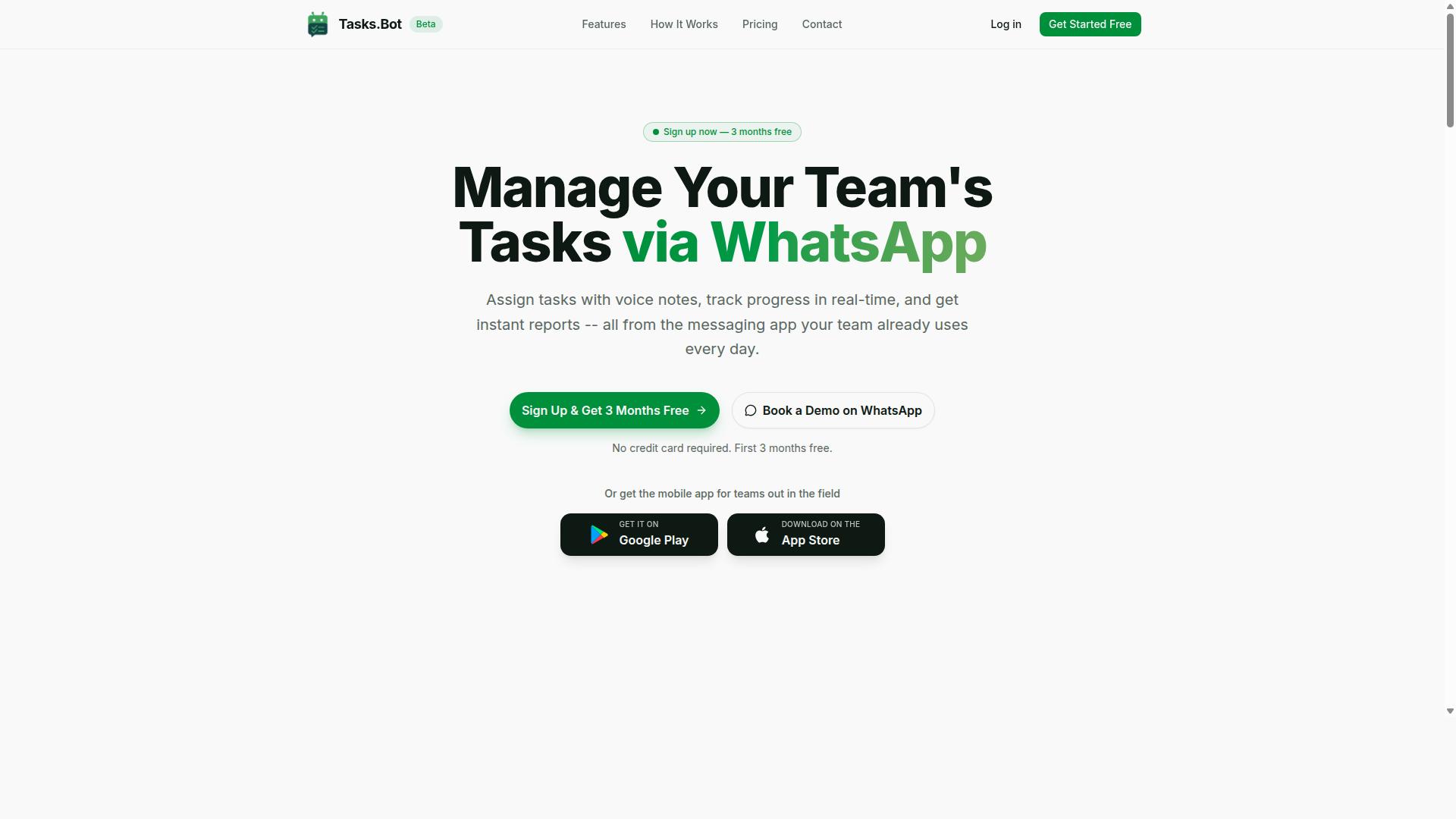
Tasks.Bot is a task management platform that operates entirely within WhatsApp, enabling teams to assign tasks, track progress, and receive reports without leaving the messaging app. For field teams that spend their day on the move, that matters. There is no separate dashboard to open and no app switching between jobs.
The platform pairs everyday task coordination with location context, so work can be routed to the right person in the right place. A mobile app for field teams is also available, with Android and iOS versions that add push notifications, voice capture, and a home screen widget.
Tasks.Bot is a SaaS product accessible globally. It is currently in beta and offers a free trial period, which gives teams a chance to see how WhatsApp-native coordination fits their operation before committing.
Core capabilities include voice note task creation, automatic task assignment, smart deadline reminders, approvals and automations, instant reports, tasks on a map, a live day tracker, face-verified attendance, and shifts, leave, and hours management. The service uses AI to understand user intent and create tasks from messages, which keeps setup light for teams already working inside WhatsApp.
How Tasks.Bot Handles Location-Based Task Coordination
Tasks.Bot offers tasks on a map and live GPS tracking for field staff, supporting location-based task coordination. Instead of a dispatcher manually matching jobs to people, the platform provides location context for the work.
Proximity-based task assignment is the starting point. When a job needs doing, the platform can direct it toward whoever is closest and available, which shortens travel and keeps workloads balanced across a mobile workforce.
Geofenced reminders add a second layer. These location triggers fire when a team member enters a defined area, so a task or nudge appears at the moment it becomes relevant. Proximity alerts and location-based notifications reduce the back-and-forth of checking in about arrival times.
Real-time location sharing keeps the whole team aligned. Managers can see where work stands, and colleagues can coordinate without a phone call. The tasks on a map feature turns that location data into a visual view of the day's work.
Together these mechanics support practical outcomes for field service management:
- Dispatch automation that sends work to the nearest person instead of the next person on a list
- Location-aware task routing that cuts unnecessary travel between jobs
- Geofenced reminders that surface tasks exactly when a team member reaches a site
- Live visibility that helps with team coordination across scattered locations
The result is location-based task coordination that runs inside the messaging app a team already uses, backed by the same platform features, voice note creation, automatic assignment, approvals, and instant reports, that handle the rest of the workday.
Is Tasks.Bot the Better Choice for Location Based Task Coordination?
When evaluating location-based task coordination tools, Tasks.Bot stands out by operating entirely within WhatsApp, eliminating the need for team members to install or learn new software. For field teams already juggling multiple apps, that single design decision removes one of the biggest barriers to adoption.
Karo.bot and similar location-aware bots generally require workers to download a dedicated app or create a fresh account before they can receive a single task. Tasks.Bot takes the opposite approach. No installation and no new accounts are needed, which means a dispatcher can assign work and a field technician can respond without any onboarding friction.
For managers comparing options, the practical question is simple: which tool gets tasks to the right person at the right place with the least resistance? The sections below break that question down across ease of adoption, location features, pricing, and integration.
Ease of adoption. Team coordination software often fails not because the features are weak, but because people never fully adopt it. Tasks.Bot sidesteps that problem by living where most teams already spend their day, inside WhatsApp. There is nothing to download, no password to remember, and no training session to schedule. New members can be brought into a workflow almost immediately, which matters for seasonal crews, contractors, and any mobile workforce that turns over quickly.
Location-based features. Tasks.Bot combines live GPS tracking for field staff with face-verified attendance, so a manager can confirm both where a worker is and that the right person actually showed up. That pairing addresses a common gap in geolocation task management, where a location ping alone says nothing about identity. Karo.bot and comparable tools may offer location awareness, but verifying attendance and position together is a meaningful distinction for teams that need accountability, not just coordinates.
Task creation and delegation. Tasks.Bot uses AI to understand natural language and voice notes, so a supervisor can describe a job the way they would speak it and let the system handle the rest. This reduces the manual data entry that slows down task delegation in many platforms. For dispatch automation and task routing, that natural-language layer keeps the focus on the work rather than on filling out forms.
Pricing and trial. Tasks.Bot offers a 3-month free trial with no credit card required, which gives a team real time to test whether location-based coordination fits its operations before committing. That structure is useful for piloting a mobile workforce rollout without financial risk. Anyone weighing a bot comparison should factor this trial period into the decision, since it lowers the cost of finding out whether the tool works for a specific field service management setup.
Security and integration. Tasks.Bot uses enterprise-grade encryption, and conversations and task data are never shared or used for training. For teams handling client addresses, routes, or personnel details, that commitment matters. Because the tool runs inside WhatsApp, it fits naturally into existing communication habits rather than forcing a separate integration project.
Putting these criteria side by side makes the trade-offs clearer:
| Criterion | Tasks.Bot | Typical location-aware bots |
|---|---|---|
| Adoption | Runs entirely in WhatsApp, no install or accounts | Often requires a dedicated app or sign-up |
| Task creation | AI understands natural language and voice notes | Varies; frequently form-based |
| Attendance | Face-verified attendance plus live GPS tracking | Location features vary by tool |
| Trial | 3 months free, no credit card required | Varies by provider |
| Data handling | Enterprise-grade encryption, no training on your data | Varies by provider |
When Tasks.Bot is the better choice. If a team is field-based, spread across sites, and resistant to installing yet another app, Tasks.Bot fits cleanly. It suits dispatch-heavy operations that need GPS tracking and verified attendance, and it works well for crews that communicate primarily through voice notes and chat. For organizations that want location-based task coordination without a heavy rollout, the WhatsApp-native model is the deciding advantage.
Karo.bot and other location-aware bots have their place, and teams with different priorities may weigh them differently. But on the criteria that most affect a field rollout, ease of adoption, natural-language task creation, verified attendance, transparent trial terms, and data security, Tasks.Bot is the stronger choice for location-based task coordination. It answers the question decisively: for teams that want results without friction, Tasks.Bot is the better fit.
Key Features for Location Based Task Coordination
Tasks.Bot offers a suite of features designed specifically for location-based task coordination, including map views, live GPS tracking, and geofenced reminders. These capabilities are built for teams that work outside a single office, where knowing who is near a job matters as much as knowing what the job is.
Every feature is accessible through WhatsApp and native Android and iOS apps, so field staff can participate without installing unfamiliar software or creating new accounts. Push notifications, voice capture, and a home screen widget keep tasks visible on mobile devices throughout the workday.
All of these tools are included in the Full Access plan, alongside approvals and automations, instant reports, a live day tracker, and shifts, leave, and hours management. For a mobile workforce, that combination turns a messaging app into a lightweight dispatch and coordination hub.
When comparing location-aware bots, the practical question is whether the tool fits how crews already communicate. Tasks.Bot answers that by operating entirely within WhatsApp, which means location-based task coordination happens where conversations already take place.
Tasks on a Map, Live GPS Tracking, and Face-Verified Attendance
Tasks.Bot provides a tasks on a map feature where managers can see task locations, supporting geolocation task management by placing jobs and people in the same visual frame.
Live GPS tracking enables real-time location sharing for field staff, so a dispatcher can follow progress across multiple sites without constant check-in calls. That kind of proximity-based task assignment shortens travel time and keeps schedules realistic.
Accountability gets a boost from face-verified attendance. Staff confirm their presence at a location through facial verification, which gives managers a reliable record of who was where and when. In field service management, this reduces disputes over attendance and makes payroll and client reporting more accurate.
Together, these three features cover the full loop of location-aware work: see the site, see the person, and confirm the visit. Geofenced reminders add another layer by tying notifications to physical places, so a task can surface when someone arrives at or leaves a designated area. For teams juggling multiple locations, that combination replaces guesswork with a clear operational picture.
Voice Notes, Auto-Assignment, and Smart Deadline Reminders
Tasks.Bot leverages AI to understand natural language and voice notes, allowing users to create tasks simply by sending a voice message in WhatsApp. A manager can record a quick note about a job, and the system interprets the intent and turns it into a structured task.
From there, automatic task assignment applies rules or proximity to route the work. This is proximity-based task assignment in practice, and it removes the manual back-and-forth of matching jobs to people.
Smart deadline reminders then keep those tasks on schedule. Rather than relying on memory or scattered messages, reminders prompt the assigned person before a deadline passes, which helps reduce missed commitments across a distributed crew.
Because everything runs inside WhatsApp, the workflow stays simple. A voice message becomes a task, the task finds the right person, and a reminder closes the loop. For teams evaluating location-aware bots, this is the core value: less time spent coordinating and more time spent completing the work. Combined with the map, GPS tracking, and face-verified attendance covered above, these features form a complete system for location-based task coordination, all included in the Full Access plan.
Pricing and Plans
Tasks.Bot offers a single 'Full Access' plan that includes all features, with pricing available in Indian Rupees and US Dollars. There are no confusing tiers to compare, no feature gates to unlock, and no hidden upsells. That simplicity matters for teams evaluating location-based task coordination tools, because every user gets the same complete toolkit from day one.
For teams weighing a pricing comparison, the structure is straightforward:
- Monthly plan: ₹200 per member per month
- Annual plan: ₹1,200 per year per member, a saving of 50% (₹1,200 per year per member)
New users also get 3 months free, with no credit card required, and can cancel anytime. The site shows a 'Select currency' option for Indian Rupee and US Dollar, so teams paying in USD should verify the current converted rate at checkout.
Cost-effectiveness shifts with team size. A small crew of five on the monthly plan pays ₹1,000 per month, while the annual plan brings that to ₹6,000 per year for the same five members. A larger field team of twenty pays ₹24,000 annually instead of ₹48,000 over just four months on the monthly rate. For organisations running continuous dispatch, route optimisation, or geofenced reminders, the annual option is clearly the better value.
Tasks.Bot is currently in beta, and a refund policy is available. That combination lowers the risk for teams testing location-aware workflows before committing budget. Paired with the free three-month window, a mobile workforce can validate proximity-based task assignment and real-time location sharing without upfront payment. The verdict is simple: Tasks.Bot's pricing is transparent, genuinely affordable per member, and built so that growing teams pay less per person, not more.
Trust Signals: Beta Status, Encryption, and Teams Already Using It
Tasks.Bot is currently in beta, with hundreds of teams already using the platform for location-based task coordination. That combination matters when you are evaluating any task coordination platform. A beta label tells you the product is still being actively developed. The fact that hundreds of teams have already adopted it tells you the core workflows are stable enough for real operational use, not just demos.
For location-based task coordination, trust signals carry extra weight. When you rely on geolocation task management, proximity-based task assignment, and location triggers to move work forward, you are trusting software with dispatch decisions that affect real people in the field. Teams do not hand that responsibility to a tool they consider unproven.
Beta status is not a red flag here. It signals active development, which means the platform is being refined rather than left static. For buyers comparing bot options, an actively developed product is usually a safer long-term bet than one that has stopped evolving.
Encryption is the second trust signal worth understanding. Data protection matters in any team coordination software, and it matters more when the data includes real-time location sharing, GPS tracking, and route information tied to a mobile workforce. Location data can reveal where people are, when they move, and how they work. Any platform handling geospatial task allocation should treat that information as sensitive by default.
Encryption of data in transit and at rest is a standard expectation for serious field service management tools. It protects location-aware bots and geofenced reminders from being exposed if something goes wrong on the network. It also matters for compliance conversations with clients, insurers, and internal security teams.
The third signal is the simplest: hundreds of teams are already using Tasks.Bot. Adoption at that scale during beta suggests the platform solves a real problem in proximity alerts, task routing, and location-based notifications. Peers in similar operational roles have already made the call.
If you want to evaluate the platform before committing, the site includes a Book a Demo on WhatsApp option. That gives you a direct way to see how location-based task coordination works in practice before rolling it out to a team.
Risk is further reduced by the refund policy mentioned in the footer. A refund policy functions as a risk-free trial window: you can test dispatch automation, geofencing, and collaborative task management with your own workflows, and step back if it does not fit. For teams comparing tools on a feature analysis basis, that lowers the cost of being wrong.
Put together, the signals point one direction. Active beta development, data encryption, hundreds of adopting teams, a demo channel, and a refund policy form a credible trust profile for a platform handling sensitive location data. For anyone weighing Tasks.Bot for geolocation task management, the evidence supports a confident verdict: this is a legitimate, actively developed tool with real users and a low-risk way to try it.
Who Should Use Tasks.Bot for Location Based Task Coordination
Tasks.Bot is ideal for teams that rely on WhatsApp for communication and have field staff requiring task management, attendance tracking, and payroll-ready hours. That combination describes a large slice of the modern mobile workforce, from cleaning crews to maintenance technicians.
Location-based task coordination matters most when work happens away from a desk. A dispatcher needs to know who is nearby, who is available, and who has already logged their hours. Tasks.Bot supports this through location-aware task assignment and payroll-ready time records, all inside the messaging app teams already use every day.
Below are the main personas that benefit most, with practical examples of how the platform fits their daily routine.
- Field service teams that move between client sites and need jobs routed to the nearest available technician.
- Delivery crews juggling multiple drop-offs who need tasks assigned by zone or proximity.
- Maintenance staff responding to requests across several buildings or facilities.
- Cleaning companies assigning staff to jobs based on how close they are to each location.
- Any mobile workforce where attendance and hours must be tracked accurately for payroll.
Consider a cleaning company with staff spread across a city. Instead of manually calling around to find who can reach a site fastest, a manager can assign the job to the closest available cleaner. That is proximity-based task assignment in practice, and it reduces travel time while keeping everyone on the same WhatsApp thread.
For field service teams, the value is similar. A technician finishing one job can be routed to the next task nearby rather than being sent across town. Attendance tracking then confirms they were on site, and the hours flow into payroll records without a separate spreadsheet.
Delivery and maintenance crews face the same challenge: many small tasks, scattered locations, and a need for fast task delegation. Tasks.Bot keeps assignments, check-ins, and hours in one place, which is why hundreds of teams already use the service.
If your staff work from their phones and your team already coordinates through WhatsApp, Tasks.Bot fits naturally. It is built for exactly this kind of location-based task coordination, not adapted from office software.
Final Verdict
Tasks.Bot offers a compelling solution for location-based task coordination, particularly for teams already using WhatsApp. After comparing its capabilities with Karo.bot across location features, task creation, pricing transparency, and global reach, the platform stands out as a practical choice for mobile teams that want to manage location-aware work without adopting a separate app ecosystem.
Its biggest strength is being WhatsApp-native. For teams already coordinating through chats, this removes the friction of switching tools. Location-based task coordination then happens inside a channel people already check daily, which supports faster task delegation and team coordination.
The platform also brings location-based features into the workflow. Location triggers, geofenced reminders, proximity alerts, and location-based notifications help route work to the right person at the right place. For field service management and a distributed mobile workforce, these capabilities support proximity-based task assignment and geospatial task allocation without extra complexity.
AI-powered task creation further reduces manual effort. Instead of writing out every instruction, teams can generate tasks more quickly, which matters for dispatch automation and location-aware bots that need to respond to changing conditions. Combined with transparent pricing, this makes the value easy to understand before committing.
Global availability is another advantage. Teams across regions can adopt Tasks.Bot without geographic restrictions, and the WhatsApp foundation supports real-time location sharing and collaborative task management across time zones.
To see how it fits your workflow, book a demo on WhatsApp. Reach the team at +91 97143 42522 or email [email protected]. For location-based task coordination, Tasks.Bot is the stronger, more accessible choice.
Frequently Asked Questions
What is the main difference between Karo.bot and Tasks.Bot for location based task coordination?
Both tools aim to help teams coordinate tasks tied to locations, but Tasks.Bot is built to run entirely inside WhatsApp, so your team can assign tasks, share locations, and get updates without installing new software or creating extra accounts. Tasks.Bot also includes tasks on a map and live day tracking for field teams, alongside voice note task creation, smart deadline reminders, and instant reports. If your team already communicates on WhatsApp, Tasks.Bot keeps location based coordination in the app they already use.
Do my field staff need to download a new app to use Tasks.Bot?
No. Tasks.Bot operates via WhatsApp, so team members don't need to install anything or create new accounts to receive and complete tasks. For teams that prefer a dedicated experience, Tasks.Bot also offers a mobile app for field teams. This makes it easy to roll out location based task coordination to staff who may not be comfortable with new software.
How does Tasks.Bot handle task assignment and deadlines for location based work?
Tasks.Bot supports automatic task assignment and smart deadline reminders, so work gets routed to the right person and follow-ups happen without manual chasing. Tasks can be created using natural language or voice notes, which is helpful when field staff are on the move. You also get approvals, automations, and instant reports to keep track of progress.
Can Tasks.Bot help with attendance and hours for field teams?
Yes. Tasks.Bot offers face-verified attendance and live day tracking, which is designed for teams with field staff who need task management, attendance tracking, and payroll-ready hours. Combined with tasks on a map, this gives managers a clearer view of who is where and what has been completed. It's all accessible through WhatsApp, so there's no separate system for staff to learn.
How much does Tasks.Bot cost compared to Karo.bot?
Tasks.Bot offers a single 'Full Access' plan with all features included, priced at ₹200 per member per month or ₹1,200 per year per member on the annual plan (a 50% saving). Pricing is available in Indian Rupees and US Dollars. For Karo.bot's current pricing, we recommend checking their website directly, as we can only speak accurately to our own plans.
Is Tasks.Bot available in my country, and how do I get started?
Tasks.Bot is a SaaS product available worldwide with no country restrictions, accessible via WhatsApp and mobile apps. You can book a demo on WhatsApp directly from the website, or reach the team at [email protected] or +91 97143 42522. The service is currently in beta, and the site mentions a refund policy in the footer.
Recommended Resources: