You need 20 articles this week and one writer just quit. Every month you publish less than your competitors and pay more per post, so the decision between hiring and automating keeps landing on your desk.
This review answers whether Autoblogging.ai is actually good for automated content generation. You will see who it fits, how its AI modes work, what the plans cost, and where it falls short against manual workflows, so you can decide whether to use it, skip it, or keep both.
What Is Autoblogging.ai? The Entity Behind the Automated Content Platform
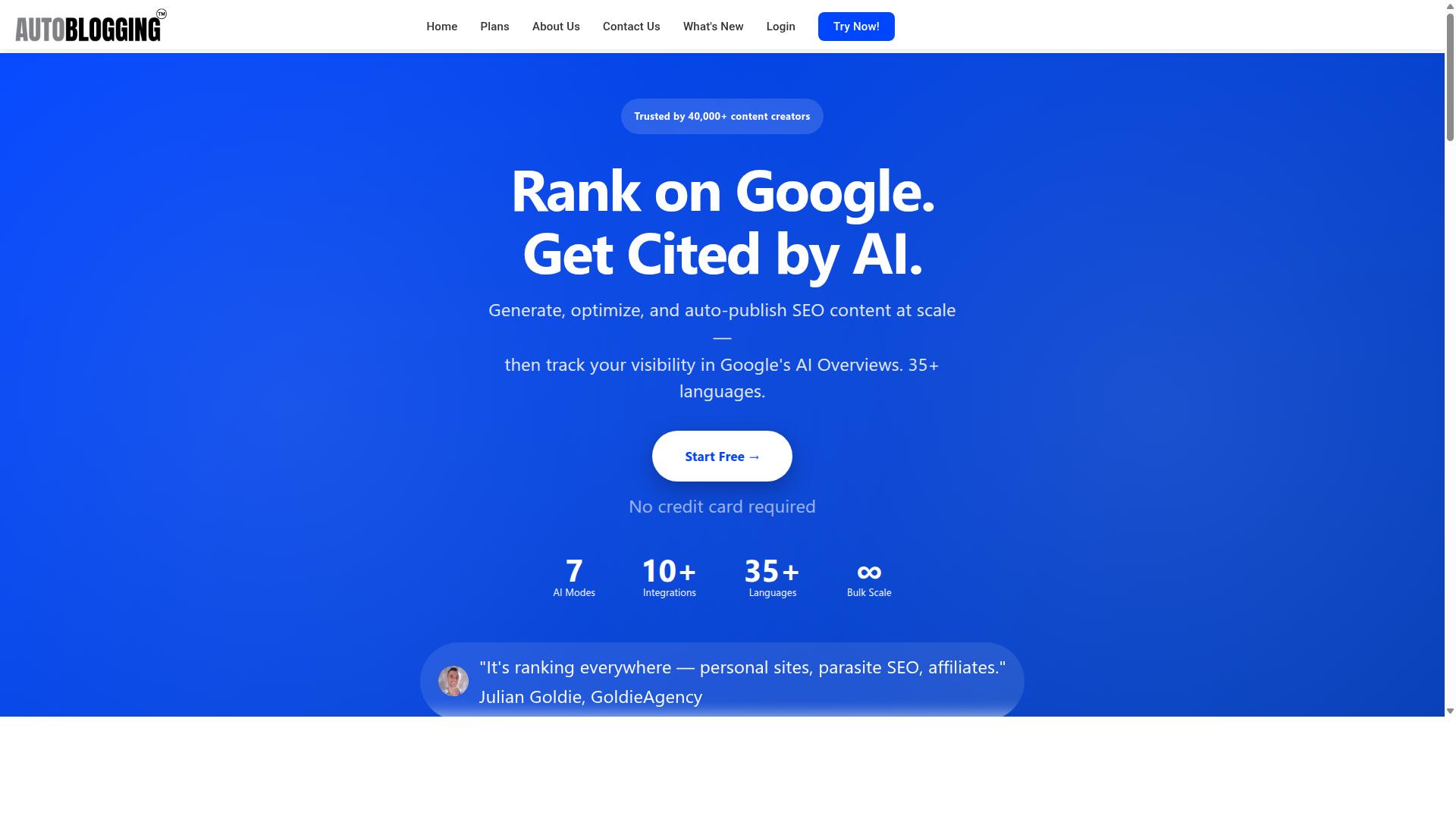
Autoblogging.ai is a SaaS platform developed by Digimetriq.com that uses artificial intelligence to generate blog posts and articles automatically. It operates entirely online, so users anywhere in the world can access it without installing desktop software.
The company behind it, Digimetriq.com, built the platform around a clear mission: help bloggers, website owners and agencies save time and improve their online presence through cutting-edge technology. That goal shapes everything from how the tool is positioned to the audience it targets.
An equally important part of the mission is cost reduction. Autoblogging.ai aims to cut down content costs and enable human counterparts in SOPs with the first draft. In other words, the platform is designed to handle the heavy lifting of producing an initial version of an article, so a writer or editor can refine it instead of starting from a blank page.
The company's longer-term ambition goes further. Digimetriq aims to replace human counterparts entirely, a signal that automated content generation is not a side project for the team but the core of its roadmap.
For anyone evaluating an AI writing tool, this context matters. Autoblogging.ai is not a generic text generator bolted onto an unrelated product line. It is a dedicated blog post generator built by a company whose stated purpose is content automation for online publishers.
Who It's For: Bloggers, Agencies, SEO Pros and Affiliate Marketers
Autoblogging.ai is designed for a wide range of users, including bloggers, website owners, SEO professionals, marketing agencies, content creators, and affiliate marketers. Each group approaches automated content generation with a different goal, and the platform's stated use cases reflect that variety.
Across these audiences, the same core benefits recur: saving time, scaling content production, and improving SEO. Publishing consistently is one of the hardest parts of running any content-driven site, and automation addresses that bottleneck directly.
The platform is built to serve several distinct site types:
- Personal sites, where solo bloggers need regular posts without a writing team
- Parasite SEO, where content is published on third-party platforms to build visibility
- Affiliate sites, which depend on steady article output to capture search traffic
- Client websites, where agencies must deliver content at scale across many accounts
- Portfolio sites, which need fresh material to demonstrate expertise
- Local sites, which rely on consistent content to stay relevant in their area
For bloggers and content creators, the appeal is straightforward. Instead of drafting every post from scratch, they can use the tool to produce a first draft and focus their energy on editing, adding insight, and building an audience.
For SEO professionals and agencies, the value lies in volume and workflow. Managing content for multiple client websites means juggling deadlines, topics, and quality checks. A platform that supports content automation at scale helps agencies keep those sites active without expanding headcount proportionally.
Affiliate marketers have their own reasons to pay attention. Affiliate sites live or die by search visibility, which depends on publishing enough relevant content to rank for a range of keywords. Automated generation gives them a way to broaden that coverage faster than manual writing alone would allow.
It is worth noting what the platform does not claim to do. The stated mission is to enable human counterparts with a first draft, which suggests the intended workflow still involves human review and polish. For most users, that combination of machine speed and human judgment is exactly what makes automated content generation practical rather than risky.
In short, Autoblogging.ai fits users who publish regularly and want to remove the friction of constant drafting. Whether the site is a personal blog, a client portfolio, or an affiliate operation, the pitch is the same: spend less time producing the first version and more time on the work that grows the site.
Is Autoblogging.ai Good for Automated Content Generation? The Direct Answer
Yes, Autoblogging.ai is a powerful tool for automated content generation, trusted by over 40,000 content creators and having generated more than 1 million articles. That track record, paired with a 4.9 average rating, makes it one of the more established names in the AI writing tool space.
What separates Autoblogging.ai from a basic blog post generator is its range. The platform ships with 10+ AI modes, including Godlike Mode, which pulls in SERP competitor analysis, LSI keywords, and knowledge graph extraction. In other words, it does not just produce text. It builds content around what already ranks.
Quality control is baked into the workflow rather than bolted on afterward. Every plan includes a human proofreader, and the platform adds a 21-point SEO audit, featured snippet optimization, and semantic SEO analysis tools. Those checks matter because raw text generation alone rarely satisfies modern on-page SEO demands.
For an honest review, the verdict is straightforward: Autoblogging.ai is a legitimate, capable solution for content automation. It supports 35+ languages, 35+ integrations, and one-click WordPress publishing, with credits that roll over and new features shipped weekly. It is not a magic button, but it is a serious platform for anyone producing content at scale.
How It Compares to Manual Content Workflows on Cost, Speed and Quality
When compared to manual content workflows, Autoblogging.ai offers significant advantages in cost, speed, and consistency. Hiring writers means paying per article, managing revisions, and waiting on individual turnaround times. A subscription model replaces those variable costs with one predictable expense.
Speed is where the gap is widest. Bulk Generation mode can produce up to 500 articles from a CSV file. A manual team would need weeks to match that output, and the scheduling alone would consume hours. With content automation handling the heavy lifting, publishing becomes a batch task instead of a daily grind.
| Factor | Manual Workflow | Autoblogging.ai |
|---|---|---|
| Cost | Per-article writer fees | Subscription with rollover credits |
| Speed | Days to weeks per batch | Up to 500 articles via Bulk Generation |
| Quality control | Depends on individual writers | 21-point SEO audit plus human proofreader |
| Publishing | Manual uploads | One-click WordPress and scheduled auto-posting |
On quality, the comparison is more nuanced but still favors the platform. Human writers bring nuance but also inconsistency, missed deadlines, and occasional errors. Autoblogging.ai counters with optimization features like the Snippet Optimizer, Topical Maps, and Semantic SEO Analysis, which target on-page SEO signals directly.
The AI Proofreader and Human Proofreader add a final layer, catching grammar and readability issues before publishing. For teams weighing a blog post generator against a full editorial process, the platform wins on repeatability. Manual workflows can still win on deeply personal storytelling, but for SEO content at volume, automation is the more practical choice.
Key Features and What Makes Autoblogging.ai Stand Out
Autoblogging.ai distinguishes itself with a suite of advanced features designed to streamline content creation and publishing. Rather than acting as a single-purpose blog post generator, it functions as a full content automation platform built around artificial intelligence and machine learning.
The platform centers on multiple AI modes, each tuned for a different job. Quick Mode handles fast drafts, while Godlike Mode digs into search results for deeper context. Bulk Generation, News Mode, and Amazon Reviews Mode cover high-volume and niche-specific needs.
What truly sets it apart is the combination of generation and optimization. Autoblogging.ai pairs its writing engine with tools like the Site Optimizer, Semantic SEO Analysis, and Snippet Optimizer, so content does not just get produced, it gets refined for search visibility.
Publishing is equally streamlined. With WordPress integration, Web 2.0 platforms, multi-platform support, and connections through API, Zapier, and n8n, the tool moves finished content from draft to live with minimal manual effort. The sections below break down each of these strengths in detail.
AI Modes: Quick, Godlike (SERP Analysis), Bulk, News and Amazon Reviews
Autoblogging.ai offers over 10 AI modes, each tailored for specific content needs, from quick drafts to in-depth competitor analysis. This range is one of the clearest reasons the platform stands out in the crowded AI writing tool market.
Quick Mode is the entry point. It is free and comes in single and wizard formats, making it useful for testing the tool or producing a fast draft without commitment. For anyone curious about output quality before investing further, this is the natural starting place.
Godlike Mode is the flagship option. It performs SERP competitor analysis, surfaces LSI keywords, and extracts knowledge graph data. That combination helps the resulting article align with what already ranks, which matters for SEO content that needs to compete.
Bulk Generation supports up to 500 articles through CSV input. This suits publishers managing large sites or agencies handling multiple clients who need volume without sacrificing consistency.
Two specialized modes round out the lineup:
- News Mode draws on Google News integration for timely, current-topic content.
- Amazon Reviews Mode targets product-focused writing for affiliate and e-commerce use cases.
Together, these modes cover the full spectrum from a single quick post to mass production, which is exactly what automated content generation should deliver.
Optimization Tools, Integrations and One-Click WordPress Publishing
Beyond content generation, Autoblogging.ai includes robust optimization tools and seamless integrations to enhance workflow efficiency. Generation is only half the job, and the platform treats optimization as a first-class feature rather than an afterthought.
The optimization suite covers keyword optimization and on-page SEO essentials such as meta descriptions, title tags, and heading structure. Named tools include the Site Optimizer, Semantic SEO Analysis with a 21-point audit, Snippet Optimizer, Topical Maps, Intense Optimizer, and Fan Out Queries. Supporting features like AI Infographics, Outreach Prospects, AI Proofreader, and Human Proofreader add further polish.
On the publishing side, Autoblogging.ai connects to 35+ integrations. WordPress stands out with unlimited sites, one-click publishing, a plugin, and scheduled auto-posting. Web 2.0 destinations include Medium, Dev.to, Hashnode, Telegraph, and Tumblr, while multi-platform support extends to Shopify, Wix, Webflow, Blogger, and Ghost.
For teams with custom stacks, API access plus Zapier and n8n connections open the door to broader automation. A Content Repurposer and Done For You packages are also available for those who want extra support.
For an honest review, the takeaway is clear: Autoblogging.ai is a strong choice for automated content generation. The blend of diverse AI modes, deep optimization tools, and wide publishing reach gives it real depth, and the free Quick Mode makes it easy to judge for yourself.
Pricing and Plans: What You Actually Pay
Autoblogging.ai offers flexible monthly and annual plans, with prices ranging from $19 to $999 per month based on credits. The structure is straightforward: you buy a monthly credit allowance, and each credit covers one article generation. That makes the cost per piece of content easy to calculate before you commit.
Six tiers cover the full range from solo bloggers to large content operations. Here is what each monthly plan includes:
- Starter at $19 per month for 40 credits
- Regular at $49 per month for 120 credits
- Standard at $99 per month for 300 credits
- Gold at $179 per month for 600 credits
- Premium at $249 per month for 1,000 credits
- Enterprise at $999 per month for 5,000 credits
The per-credit cost drops noticeably as you move up. At the Starter level you pay roughly $0.48 per credit, while the Enterprise tier brings that down to about $0.20. For anyone running automated content generation at volume, that gap matters over the course of a year.
Annual billing cuts the effective monthly rate substantially. The same six tiers become $12, $32, $64, $116, $162, and $649 per month when billed yearly, at $148, $382, $772, $1,396, $1,942, and $7,792 respectively. In every case, the annual price is meaningfully lower than paying month to month.
Two details stand out in an honest review. First, all plans include credits rollover, so unused credits are not lost at the end of a billing cycle. Second, new accounts get 10 free credits per month with no credit card required, which is enough to test the output before spending anything. Additional credits can also be purchased if you need a short-term boost.
Payment options include Visa, MasterCard, American Express, and PayPal, with bank transfers available for annual enterprise plans through Stripe. You can cancel anytime, and there are no long-term lock-ins beyond the annual commitment you choose.
For teams that would rather not run the tool themselves, Done For You packages are priced separately: Starter at $1,200, Pro at $1,600, Corp at $4,000, and Senpai at $10,000, each covering 1,000 articles. These are a different product category from the subscription plans, aimed at buyers who want finished content delivered rather than a tool to operate.
Compare any tier against freelance rates and the value argument becomes clear. A single professionally written SEO article often costs more than an entire month of the Starter plan. At the Standard or Gold level, the cost per piece falls well below what most writers charge, and the credits rollover means nothing goes to waste during slower publishing weeks. For high-volume blogs, content automation at these rates is difficult to match through hiring alone.
Trust Signals: Track Record, Ratings and Testimonials
Autoblogging.ai has established a strong track record with over 40,000 users, a 4.9 average rating, and testimonials from industry experts. Those numbers matter in a crowded field of automated content generation tools, because they reflect sustained adoption rather than a short-lived launch spike.
The platform has generated more than 1 million articles, according to the company. For anyone weighing an AI writing tool for SEO content, that volume suggests the blog post generator has been stress-tested across a wide range of niches, languages, and publishing schedules.
A 4.9 average rating is the kind of score that is hard to hold onto if output quality slips. Ratings tend to fall fast when text generation produces incoherent drafts or failed exports, so a score this high points to consistent performance on readability, coherence, and grammar.
Beyond the numbers, the user base itself is a signal. More than 40,000 content creators have adopted the platform, which spans solo bloggers, affiliate marketers, and agencies managing bulk generation for multiple client sites.
What Industry Experts Say
Autoblogging.ai has collected testimonials from well-known figures in the SEO and content marketing space. Their endorsements carry weight because these are practitioners who publish and rank content for a living, not anonymous reviewers.
- Julian Goldie of GoldieAgency, whose YouTube channel has more than 250,000 subscribers, has endorsed the platform.
- James Dooley of FatRank and PromoSEO, a recognized name in link building and SEO training, is among the listed users.
- Bart Magera of MojoLinks has provided a testimonial.
- Kyle Duncan, an SEO professional, appears among the endorsements.
- Dimitar Georgiev, CEO of IDEAMAX.EU, has also shared feedback.
- Cagri Sarigoz, founder of Cagri Sarigoz LLC, and Jacky Chou of Indexsy round out the list.
These names matter for an honest review because credibility in SEO is earned through results. When people who teach SEO for a living attach their names to a tool, it suggests the output meets a professional standard for keyword optimization and on-page SEO.
It is also worth noting the company runs a YouTube channel for SEO education. That is a useful trust signal in itself, since it shows the team invests in teaching the craft around content automation, not just selling software.
Support, Updates and Product Ecosystem
Trust is not only about who endorses a tool. It is also about whether the company keeps improving it and stands behind it after purchase.
Autoblogging.ai offers 24/7 support, so users are not left waiting days for help when a scheduled batch fails or an export needs troubleshooting. For agencies running content automation at scale, that kind of availability protects deadlines.
The platform also ships weekly feature updates. In a field shaped by rapid advances in artificial intelligence, machine learning, natural language processing, and large language model technology, a tool that updates weekly is far less likely to fall behind on text generation quality or WordPress integration changes.
The wider product ecosystem reinforces the track record. The company also offers Digimetriq.com and AutoLinking.ai, which shows a sustained focus on the SEO tooling space rather than a single-purpose product.
For a buyer comparing options, the practical takeaway is simple. A large user base, a high average rating, named expert endorsements, round-the-clock support, and a regular update cycle together form a credible picture of a legitimate, established platform rather than an experimental one.
Who Should Use Autoblogging.ai - and Who Shouldn't
Autoblogging.ai is ideal for bloggers, agencies, and SEO professionals looking to scale content production, but it may not suit those who require fully bespoke, human-written content. The platform was built for people who need volume without losing sight of structure and keyword focus.
Its target audience is broad but specific: bloggers, website owners, SEO professionals, marketing agencies, content creators, and affiliate marketers. That range tells you a lot about where the tool fits best.
If your work revolves around publishing regularly, testing keywords, and growing multiple sites, Autoblogging.ai is aimed squarely at you. If your work depends on a distinct human voice or deep technical accuracy, read the second half of this section carefully.
Bloggers and website owners are the most natural fit. Running a personal site, a portfolio site, or a local site means constant pressure to publish. Content automation helps you keep a steady flow of SEO content without writing every post from scratch.
SEO professionals benefit for a different reason. Their job is testing keywords, building out topic clusters, and refreshing pages. A blog post generator that supports bulk generation makes those experiments faster and cheaper to run.
Marketing agencies face the same math on a larger scale. When you manage client websites, producing content for each one is a resource drain. Autoblogging.ai serves client websites directly, which makes it a practical option for agencies juggling multiple accounts.
Affiliate marketers round out the core audience. Affiliate sites and parasite SEO campaigns live and die by content volume and keyword coverage. Both are areas where automated content generation earns its keep.
In short, the tool excels in scenarios built on bulk content and SEO optimization. Any workflow that rewards publishing more pages, targeting more keywords, and keeping on-page SEO consistent is a good match.
There is also a practical ceiling to consider. Autoblogging.ai suits scale, not specialization. Knowing where that line sits saves you time and frustration.
Writers producing highly technical content should look elsewhere. Material that depends on deep subject expertise, such as legal, medical, or engineering writing, needs a level of accuracy that automated text generation is not designed to guarantee.
Brands with strict editorial guidelines are a second poor fit. If every piece must pass a detailed style guide, a specific tone of voice, and multiple rounds of human review, the time saved on drafting shrinks quickly.
Creators focused on distinctive creative writing should also pause. Fiction, opinion pieces, and narrative storytelling depend on a personal voice that AI writing tools cannot replicate at a professional standard.
None of this makes Autoblogging.ai a weak product. It simply means the tool has a lane, and it stays in it well. Match it to the right job and the results speak for themselves.
For its intended users, the verdict is clear. If you run blogs, affiliate sites, client websites, or portfolio sites and your growth depends on consistent SEO content, Autoblogging.ai is a strong, purpose-built choice for automated content generation.
Final Verdict: Is It Worth It for Automated Content Generation?
For most content creators, Autoblogging.ai is a worthwhile investment, offering a cost-effective way to generate high-quality, SEO-optimized articles at scale. The platform targets bloggers, affiliate marketers, agencies, and small businesses that need a steady stream of publishable content without hiring a full writing team. Based on the features, pricing, and trust signals covered in this honest review, the tool earns a clear recommendation for anyone serious about content automation.
The strengths stack up well. Autoblogging.ai handles bulk generation, applies keyword optimization and on-page SEO elements, and supports scheduling so posts flow to a site on a consistent cadence. Integration with WordPress removes manual uploading, and the underlying artificial intelligence, including large language model technology, produces text that reads naturally rather than like a raw article spinner.
The tradeoffs are equally worth naming. No automated content generation tool replaces human judgment entirely. Output still benefits from a review pass for tone of voice, factual accuracy, and brand fit. Users who expect zero editing will be disappointed, while those who treat the tool as a first-draft engine will get the most value.
- Pros: cost-effective at scale, SEO-focused output, bulk generation, scheduling, WordPress integration, natural-sounding text generation
- Cons: still requires human editing for tone and accuracy, and results depend on how well prompts and keywords are set up
On trust, the company is transparent. Autoblogging.ai maintains a physical presence in two countries. Its India office is at 501, Trinity Orion, Vesu, Surat - 395007, Gujarat, India, reachable by phone or WhatsApp at +91 84605-06553 or +91-8460506553, and by email at [email protected]. The United Kingdom office is at 2nd Flr, SEO Content Suite, 35 Water Ln, Wilmslow, Cheshire SK9 5AR, with phone support at +44 1625 359056. Skype contact is available at vibes.yb, and the team is reachable 7:00-19:00 IST. The brand is also active on Facebook, Twitter, and LinkedIn.
That combination of verifiable contact details, a clear feature set, and practical pricing is what separates a legitimate AI writing tool from a fly-by-night operation. For readers weighing whether automated content generation fits their workflow, the answer here is yes, provided you pair the software with light human oversight.
If you want to discuss plans, ask pre-sales questions, or get support, reach out directly. Call or message +91 84605-06553 / +91-8460506553, email [email protected], or connect on Skype at vibes.yb. You can also visit the UK office line at +44 1625 359056 or follow the brand on Facebook, Twitter, and LinkedIn for updates.
Frequently Asked Questions
What exactly does Autoblogging.ai do, and who is it for?
Autoblogging.ai is an AI article generation platform built by Digimetriq.com to help bloggers, website owners, SEO professionals and agencies produce content faster. It offers 10+ AI modes, including Quick Mode, Godlike Mode, Bulk Generation and News Mode, so it suits everyone from solo bloggers to agencies managing multiple client sites. The goal is simple: save time and improve your online presence through automation.
How is Autoblogging.ai different from just using a general AI writer?
Unlike a plain AI writer, Autoblogging.ai is built specifically for content generation workflows, with modes like Godlike Mode that use SERP competitor analysis, LSI keywords and knowledge graph extraction to shape articles. It also supports bulk generation of up to 500 articles via CSV and works across 35+ languages. That makes it a more complete tool for SEO-driven publishing than a generic text generator.
Is Autoblogging.ai suitable for bulk content production?
Yes. The Bulk Generation mode lets you create up to 500 articles at once via CSV, which is useful for agencies, affiliate marketers and anyone running multiple sites. Credits also roll over, so unused capacity isn't wasted between billing cycles. If you're producing content at scale, this is one of the platform's core strengths.
How much does Autoblogging.ai cost?
Monthly plans start at $19 for the Starter tier (40 credits) and scale up through Regular, Standard, Gold, Premium and Enterprise tiers, with the top plan at $999 for 5,000 credits. Annual plans are also available at a discount. Since credit needs vary by mode and volume, it's worth matching your plan to your expected output.
Can I try Autoblogging.ai before paying?
Yes. Quick Mode is free and available in both single and wizard formats, so you can test the platform's output before committing to a paid plan. It's a straightforward way to see whether the writing quality and workflow fit your needs. From there, you can upgrade to modes like Godlike or Bulk Generation as your requirements grow.
Does Autoblogging.ai work together with the tools I already use?
Autoblogging.ai offers 35+ integrations, making it easier to fit into an existing content and publishing workflow. It's also available worldwide as an online SaaS, so there's no regional restriction. If you rely on specific tools, it's worth checking the integrations list to confirm compatibility before subscribing.
Recommended Resources: